H.webp&w=3840&q=75)
Sri Sri Durga Puja
The complete royal Sri Sri Durga Puja — from Shashti Kalparambha and Bodhan to Sandhi Puja, Maha Navami Homa and Darpan Visarjan — revived in its full Agamic sequence in KAILASA's Temples Around the World.
From Shashti (16 October) to Dashami (21 October), KAILASA revives the full royal Sri Sri Durga Puja exactly as it was once performed by the Kings, Queens and Heads of Hindu States. Under the guidance of THE SUPREME PONTIFF OF HINDUISM BHAGAVAN SRI NITHYANANDA PARAMASHIVAM, a rite that had all but disappeared from lived practice outside Bengal and a handful of royal households is restored to its complete Agamic sequence in KAILASA's Temples Around the World.
Every seva of the Durga Puja sequence is described below, in the order in which it is offered, with its own significance and timing.
Significance
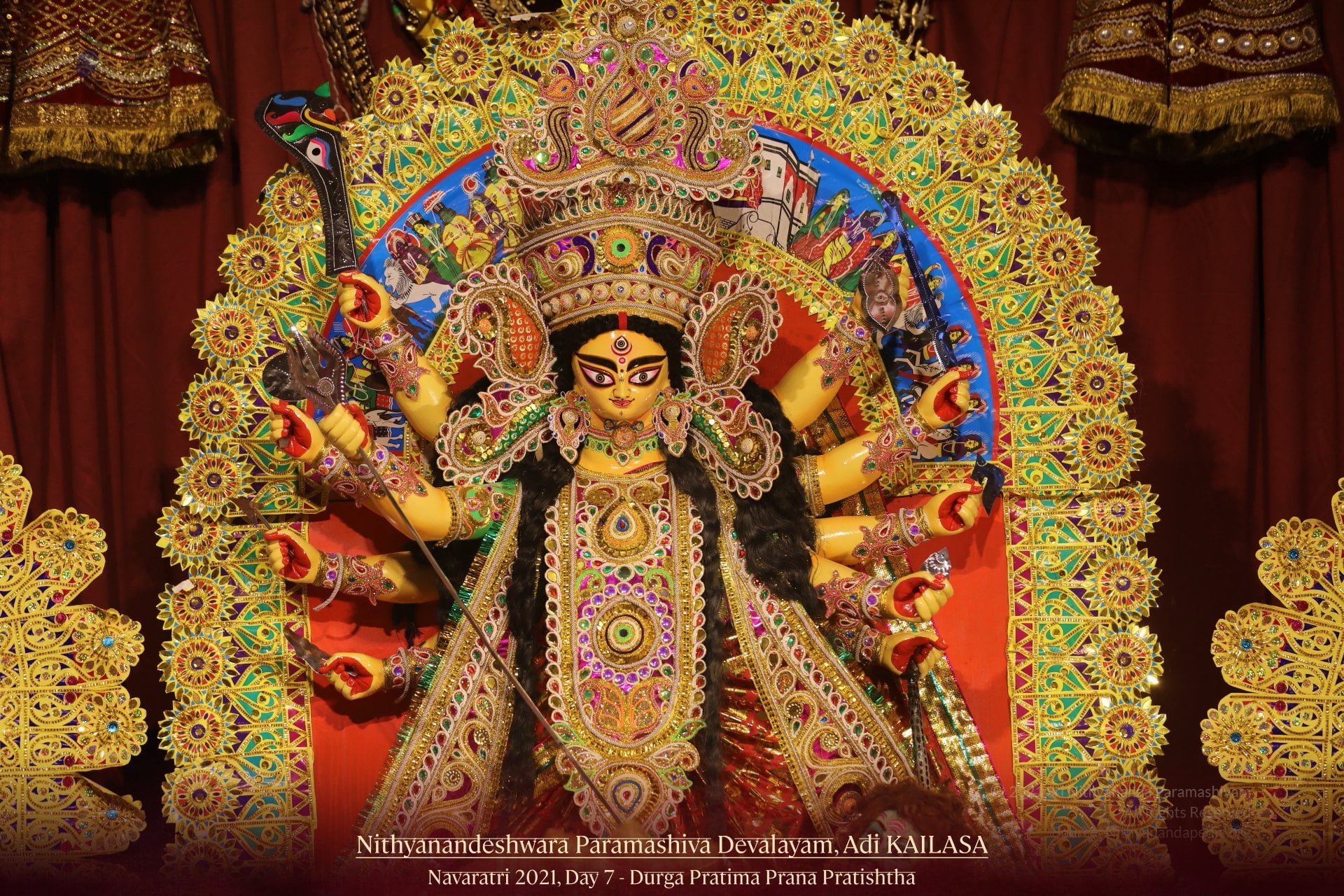
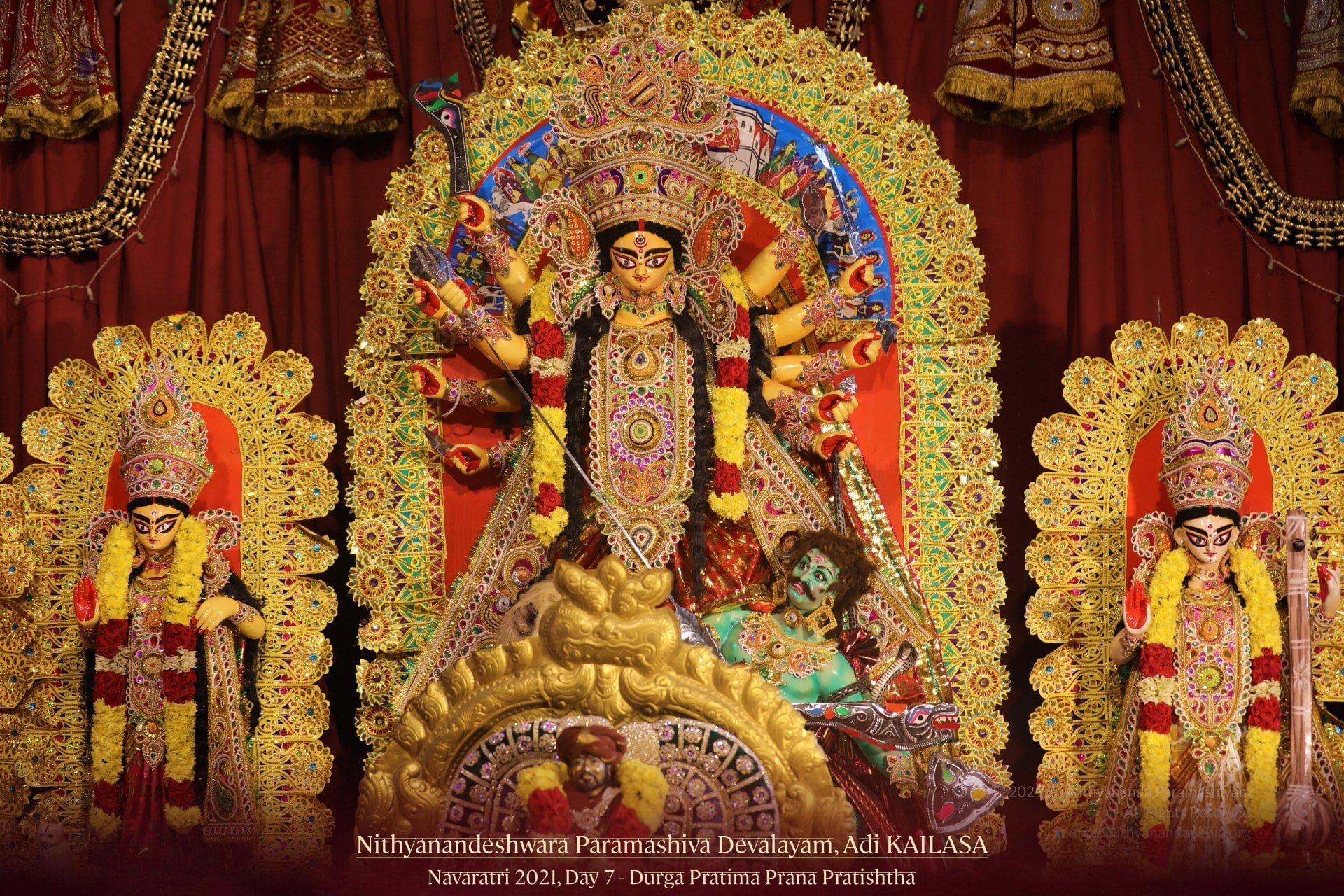
Worship of the Divine Mother is among the oldest forms of worship known to humanity, and it is in the Devi Mahatmyam — the Chandi — that this Mother worship first receives full, independent and supreme scriptural status. The image of Durga at the center of this Puja — ten-armed, astride her lion, in the very act of slaying the buffalo-demon Mahishasura — is not decoration: once the Prana Pratishtha is done, she is no longer an image but the living Goddess Herself, ALIVE and BREATHING, radiating power, knowledge, love and joy.
The Chandi's telling of this battle glorifies Shakti in her higher, maternal, protecting form; it honors the reality of hardship as squarely as it honors virtue; it shows the strength and sovereignty the feminine carries; and above all it delivers a message of hope — that whatever difficulty comes, there is a Mother behind every devotee who protects them or gives them the inner strength to face it. Within KAILASA, this entire arc is worshipped as THE SPH's own living presence as Devi Durga.
The Sevas of Sri Sri Durga Puja
1. Shashti Kalparambha
Kalparambha is the sankalpa — the firm ritual intention to conduct the Puja properly across the coming days. Offering this seva places the devotee's own sankalpa at the very foundation of the entire Durga Puja.
When: Day 6 · Fri 16 Oct — 5:30 AM IST (Thu 15 Oct, 8:00 PM ET)
2. Shashti Bodhan
Bodhan — literally "awakening" — is the invocation asking Devi, who is understood to rest during this half of the year, to wake and be present. It is the same ritual Sri Rama is remembered to have performed before his battle with Ravana.
When: Day 6 · Fri 16 Oct — 6:00 PM IST (Fri 16 Oct, 8:30 AM ET)
3. Amantran & Adhivas
The sanctification and formal invitation of Devi to accept the worship that follows. The night before, the Chandi Paath — the recitation of the Devi Mahatmyam — fills the temple with the story of the Mother's victory, preparing the space for her arrival.
When: Day 7 · Sat 17 Oct — 6:00 PM IST (Sat 17 Oct, 8:30 AM ET)
4. Durga Pratima Yajaman
The Durga Pratima Yajaman sponsors the sacred image (Pratima) of Devi Durga herself — the very deity into whom Prana Pratishtha is breathed on Maha Saptami by THE SPH's own hands. The Yajaman's sankalpa is bound to the commissioning, consecration and worship of this Pratima, which will be worshipped, invoked and finally immersed across the remaining days. It is among the most significant single offerings of the entire sequence: the Yajaman's name remains bound to the deity's own manifestation this Navaratri.
When: offered for the Maha Saptami Prana Pratishtha (Day 8 · Sun 18 Oct) and the days that follow.
5. Maha Saptami Puja
The Prana Pratishtha — when THE SPH's own hands consecrate and breathe life into the Devi murti — followed by the sixteen-step Shodashopachara Puja. From this moment the Pratima is worshipped as the living Mother.
When: Day 8 · Sun 18 Oct — 5:30 AM IST (Sat 17 Oct, 8:00 PM ET)
6. Daily Sandhya Arati & Bhog
Once Devi is awakened and alive in the Pratima, she is honored every evening as a sovereign guest: the Sandhya Arati waves the ceremonial lamps before her at dusk, and the Bhog offers her freshly prepared food. Offering this seva is feeding and adoring the Mother herself, day after day, while she dwells among her children.
When: Day 8 · Sun 18 Oct — 6:00 PM IST (Sun 18 Oct, 8:30 AM ET); Day 9 · Mon 19 Oct — 6:00 PM IST (Mon 19 Oct, 8:30 AM ET); Day 10 · Tue 20 Oct — 6:00 PM IST (Tue 20 Oct, 8:30 AM ET)
7. Maha Ashtami Puja & Kumari Puja
Devi is worshipped in her nine aspects, and a young girl is honored as a living manifestation of the Divine Mother — the tradition holding that Devi's presence shows more purely through a pure-hearted child than through any grown deity-image.
When: Day 9 · Mon 19 Oct — 5:30 AM IST (Sun 18 Oct, 8:00 PM ET)
8. Sandhi Puja — the most powerful window
The Sandhi Puja falls across the last twenty-four minutes of Ashtami and the first twenty-four minutes of Navami — forty-eight minutes considered the most auspicious juncture of the whole festival. It ritually recreates the exact moment Durga, as Chamunda, slays Mahishasura, the embodiment of accumulated collective negativity; it is regarded as the instant Devi's presence in the cosmos is most concentrated and cosmic Dharma is set back into place. Any devotee seeking Durga Devi's direct, personal intervention in a genuinely difficult life situation is counseled not to miss offering seva at this moment.
When: Day 9 · Mon 19 Oct — 10:28 AM to 11:16 AM IST (begins 12:58 AM ET).
9. Maha Navami Puja
The worship of the Mother on the ninth day, the eve of her victory — the Navami that the Sandhi Puja has just ushered in.
When: Day 10 · Tue 20 Oct — 5:30 AM IST (Mon 19 Oct, 8:00 PM ET)
10. Maha Navami Homa
The fire ritual that reinstalls Durga within the devotee as the element of Agni itself — the outer worship of the preceding days turned inward.
When: Day 10 · Tue 20 Oct — 1:00 PM IST (Tue 20 Oct, 3:30 AM ET)
11. Dashami Puja & Darpan Visarjan
The closing of the entire Durga Puja and Navaratri cycle. A brief Puja and a cooling food offering (Shital Bhog) are made, followed by Arati. Then the Darpan Visarjan — the ceremonial circumambulation and immersion of the sacred mirror in which Devi's reflected presence has been held — entreats the Mother to return to her celestial abode. Though ritually released, she dwells forever in the hearts of her devotees: sadhana intensely practiced, its fruit received, and carried forward into daily life.
When: Dashami Puja & Darpan Visarjan · Wed 21 Oct — 5:30 AM IST (Tue 20 Oct, 8:00 PM ET)
Shastra Pramana
दुर्गे स्मृता हरसि भीतिमशेष जन्तोः स्वस्थैः स्मृता मतिमतीव शुभां ददासि । दारिद्र्य दुःख भय हारिणि का त्वदन्या सर्वोपकार करणाय सदार्द्रचित्ता ॥
durge smṛtā harasi bhītimaśeṣa jantoḥ svasthaiḥ smṛtā matimatīva śubhāṃ dadāsi | dāridrya duḥkha bhaya-hāriṇi kā tvadanyā sarvopakāra karaṇāya sadārdra-cittā ||
Translation: “O Durga, when called to mind in a difficult pass, you remove fear for every being. When called to mind by those in happiness, you bestow a mind still more pious. Which goddess but you, O Dispeller of poverty, pain, and fear, has an ever-sympathetic heart for helping everyone?” — Devi Mahatmyam, Chapter 4, Verse 17
The Sandhi Puja invokes the ferocious aspect of the Mother praised in Brahma's hymn of the first chapter: kālarātrirmahārātrirmoharātriśca dāruṇā — "She is Kalaratri, Maharatri, and the terrible Moharatri." The second and third episodes of the Devi Mahatmyam — the slaying of Mahishasura, and Ambika-Kali's destruction of Shumbha and Nishumbha — are the very narratives re-enacted, day by day, across this sequence.
Benefits
- A sustained, multi-day communion with the Cosmic Mother as she comes to protect her children — among the rarest acts of devotion a devotee can offer in this lifetime.
- Direct intervention and rescue in difficult life situations, especially through the Sandhi Puja.
- Freedom from fear, poverty and pain, as the Devi Mahatmyam promises to those who remember Durga.
- The dissolving of self-destructive and group-destructive patterns as ego is surrendered at the Guru's feet.
- Long, healthy, prosperous lives, and the inspiration to live as Tyagis and Yogis — giving to others while receiving.
- Durga's grace permanently seated in the heart, even after the Pratima is released.